
Department of Innovative Biomedical Visualization (iBMV)
KEYWORDS
- Brain MRI
- Interstitial dynamics
- AI
HEAD

LAB MEMBER
| Faculty | Position | Researchers |
|---|---|---|
| ITO Rintaro | Lecturer | Researchers |
CONTACT
| iga-ken-d◎t.mail.nagoya-u.ac.jp (Please send a message after replacing "◎" mark with "@" mark. ) | |
| HP | Private Page |
OUTLINE
The aim of this department is to obtain quantitative anatomical, physiological, and pathological information of the central nervous system and other biological tissues through advanced magnetic resonance imaging and artificial intelligence. A primary research focus is the elucidation of the morphology and dynamics of interstitial spaces within the central nervous system, which remain less explored compared with vascular structures, perfusion, and neuronal networks. We investigate neurofluid dynamics, including cerebrospinal and interstitial fluids, as a key frontier for understanding brain function and maintaining brain health. In addition, the department studies the endolymphatic system of the inner ear using artificial intelligence and machine learning–based approaches to develop objective and automated evaluation methods that support consistent patient management.
RESEARCH PROJECTS
- Neurofluid dynamics in the central nervous system
- MRI evaluation of the glymphatic system
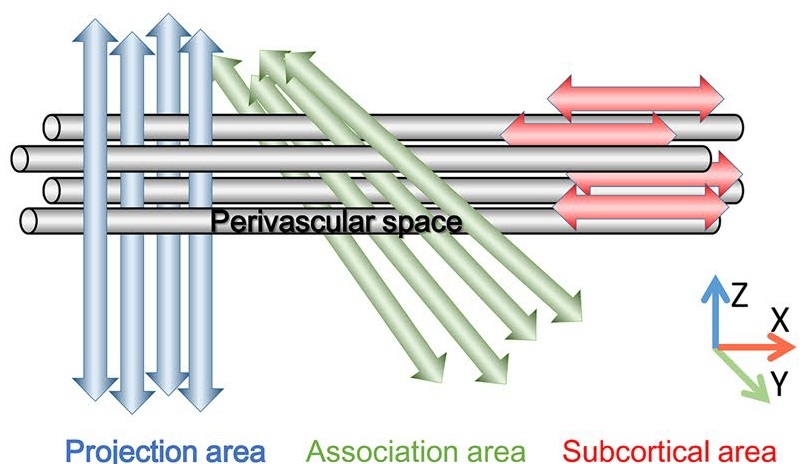
- Diffusion MRI: DTI-ALPS(Fig), time-dependent diffusion
- Cerebrospinal fluid and contrast-agent clearance
- Venous and meningeal lymphatic–related spaces
- Neurofluid dynamics in sleep, aging, and disease
- MRI evaluation of the inner ear endolymphatic system
- AI and machine learning–based imaging analysis
- AI applications in radiology and nuclear medicine
BIBLIOGRAPHY
2025
- Quantitative MRI evaluation of glymphatic function and brain interstitial fluid dynamics (DTI-ALPS method): Taoka T, et al. Jpn J Radiol, 2025
- MRI evaluation of the effects of sleep and pharmacological interventions on brain interstitial fluid dynamics: Taoka T, et al. Magn Reson Med Sci, 2025
- Association between perivascular spaces and white matter microstructure in obstructive sleep apnea syndrome: Taoka T, et al. Jpn J Radiol, 2025
- Investigation of cerebrospinal fluid and contrast-agent clearance mechanisms using contrast-enhanced MRI: Naganawa S, et al. Magn Reson Med Sci, 2024–2025
- Clinical performance evaluation of AI-based brain aneurysm detection software: Ito R, et al. Magn Reson Med Sci, 2025
- Evaluation of large language models and vision–language models for radiological interpretation: Ito R, et al. Ann Nucl Med, 2025
- Evaluation of large language models and vision–language models for radiological interpretation: Ito R, et al. EJNMMI Reports, 2025
2024
- Quantitative MRI evaluation of glymphatic function and brain interstitial fluid dynamics (DTI-ALPS method): Taoka T, et al. Magn Reson Med Sci, 2024
- Investigation of cerebrospinal fluid and contrast-agent clearance mechanisms using contrast-enhanced MRI: Naganawa S, et al. Magn Reson Med Sci, 2024–2025
- Imaging evaluation of meningeal lymphatics and venous-related spaces: Nakamichi R, et al. Jpn J Radiol, 2024
- Imaging evaluation of meningeal lymphatics and venous-related spaces: Naganawa S, et al. Magn Reson Med Sci, 2024
