
Department of Neuropsychopharmacology and Hospital Pharmacy
KEYWORDS
- Neuropsychiatric disorders
- Pharmacotherapy
HEAD

LAB MEMBER
| Faculty | Position | Researchers |
|---|---|---|
| MIZOGUCHI Hiroyuki | Associate Professor | Researchers |
| MATSUZAKI Tetsuo | Designated Assistant Professor |
CONTACT
| pharmacy◎med.nagoya-u.ac.jp (Please send a message after replacing "◎" mark with "@" mark. ) | |
| HP | Private Page |
OUTLINE
The brain controls directly or indirectly all physiological activities, from heart rate to memory. Each brain function is regulated by specific neural circuits composed of neurons interconnected by synapses. A key feature of synapses is their activity-dependent plasticity. Our laboratory primarily investigates neuropsychiatric disorders and higher brain functions. Our research on neuropsychiatric disorders aims to elucidate the etiology and pathophysiology of conditions such as schizophrenia, drug addiction, and Alzheimer’s disease. In addition, our studies on higher brain functions focus on uncovering the molecular and cellular mechanisms underlying learning and memory, emotion, motivation, and decision-making.
Our laboratory also researches pharmacotherapy procedures and outcomes. Pharmacotherapy is often associated with adverse drug reactions, making safety management a critical component of clinical practice. Our research aims to improve the safety of pharmacotherapy by identifying risk factors for adverse events and optimizing patient-specific monitoring strategies, supportive care, and dosage regimens to prevent or mitigate toxicity.
RESEARCH PROJECTS
1. The neural circuits of motivation and decision-making
Decision-making is a key function in everyday life. The inability to make appropriate decisions or to anticipate the possible consequences of decisions can result in personal, social, and financial problems. Impaired decision-making is a symptom of several neuropsychiatric diseases, such as depression, schizophrenia, Parkinson’s disease, and drug dependence. Patients with anorexia, bulimia, and obesity also exhibit decision-making deficits on the Iowa gambling task, indicating that the reward system is impaired in compulsive food-related disorders. Impairment of decision-making in neuropsychiatric disorders is associated with an inability to make profitable long-term decisions that incorporate expectations of future outcomes. Impaired decision-making is therefore recognized as a core problem in neuropsychiatric disorders; however, the underlying neuronal mechanisms are largely unknown. To gain insights into these mechanisms and to develop successful treatments for these diseases, we examine impaired decision-making in animal models of neuropsychiatric disorders. We also investigate the neuronal mechanisms of motivation, which drives the initiation of actions (decision-making) based on internal desires.
2. Pathophysiological mechanisms of schizophrenia and the development of novel therapeutic drugs
Schizophrenia is a severe psychiatric disorder that typically emerges in late adolescence and early adulthood. It affects approximately 1% of the population and involves positive symptoms (such as hallucinations and delusions), negative symptoms (such as flat affect and social withdrawal), and cognitive dysfunction (such as deteriorations in working memory, executive function, and learning). The pathoetiology of schizophrenia is not fully understood because of its complexity and heterogeneity. However, copy-number variations in the ARHGAP10 gene, which encodes Rho GTPase activating protein 10, are associated with schizophrenia. We have explored the pathomechanism of schizophrenia using model mice that carry “double-hit” variations in the Arhgap10 gene (Arhgap10 S490P/NHEJ mice). These mice model the genetic variations found in a Japanese patient with schizophrenia and mimic the patient’s phenotype histologically and behaviorally. We have found that targeting RhoA/Rho-kinase signaling may provide new therapeutic approaches for the treatment of schizophrenia patients, including those with ARHGAP10 variations (Fig. 1). Furthermore, we have identified Twinfilin 1 as a downstream effector of reelin signaling via phosphoproteomic analysis, and demonstrated Twinfilin 1 phosphorylation to be a key component of reelin-mediated actin remodeling and dendritic spine development (Fig. 2).
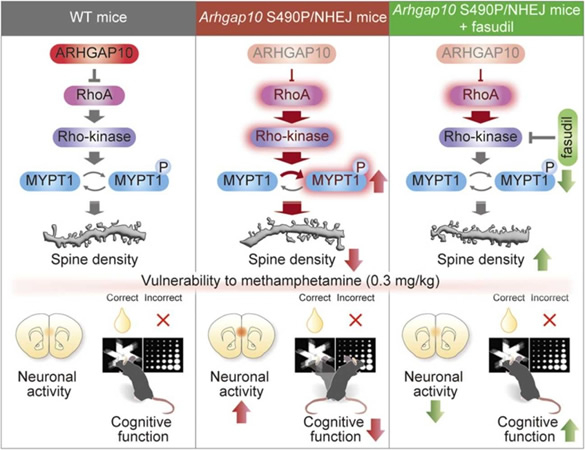
Fig. 1. A Rho kinase inhibitor ameliorates cognitive deficits and spine formation abnormalities in Arhgap10 S490P/NHEJ mice. (Tanaka et al., Pharmacol Res, 2023;187: 106589, CC BY-NC ND)
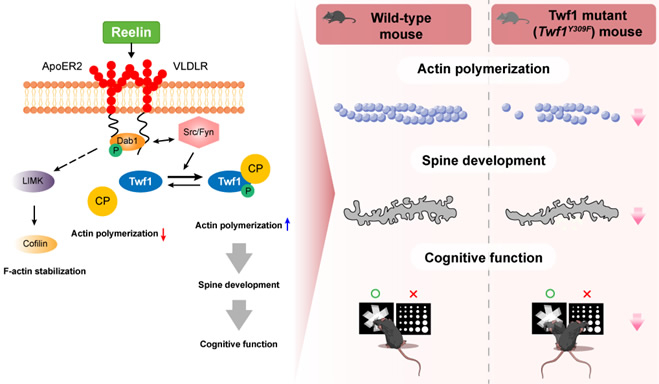
Fig. 2. Phosphorylation of Twinfilin 1 (Twf1) contributes to Reelin-mediated actin remodeling and spine formation, and plays a role in learning and memory. (Dong et al., Pharmacol Res, 2025; 221:107986, CC BY-NC-ND)
3. Pathophysiological mechanisms of neurocognitive disorder
Neurodegenerative diseases, such as Alzheimer’s disease and frontotemporal dementia, are clinically characterized by impairments in cognitive and sensorimotor function and by neuropathological processes. These processes are commonly associated with age-related protein aggregation. Alzheimer’s disease is marked by the presence of extracellular senile plaques, composed of amyloid beta peptides, and intracellular neurofibrillary tangles, which consist of bundles of paired helical filaments of the microtubule-associated protein, Tau. The molecular mechanisms linking the aggregation of these proteins and neurodegeneration remain to be elucidated. To examine the mechanism of neurocognitive decline, we have found touchscreen-based tasks to be effective. We have used such tasks to assess cognitive impairment and to detect Alzheimer’s disease-associated behavioral impairments with high sensitivity at an early stage (Fig. 3). Moreover, we have demonstrated that specific genetic characteristics of glial cells may lead to abnormal behavior in an animal model of neurocognitive disorder.
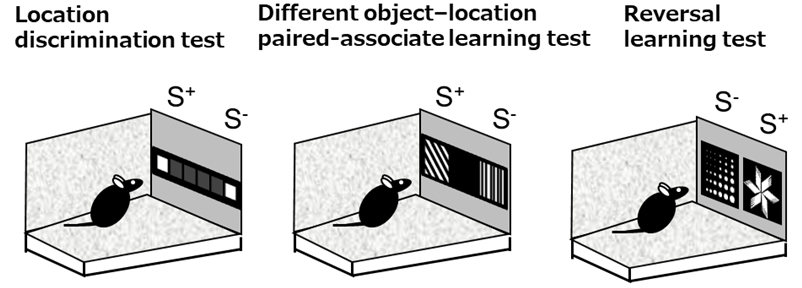
Fig. 3. Development of a system for early detection of cognitive impairment in an Alzheimer’s disease mouse model.
4. Improving the safety of pharmacotherapy and evaluating the role of pharmacists in inter-professional collaboration
Pharmacotherapy is often associated with adverse drug reactions, making safety management a critical component of clinical practice. Our research aims to improve the safety of pharmacotherapy by identifying risk factors for adverse events and optimizing patient-specific monitoring strategies, supportive care, and dosage regimens to prevent or mitigate toxicity.
Given the substantial inter-individual variability in pharmacokinetics, we comprehensively evaluate drug absorption, distribution, metabolism, excretion, and drug–drug interactions. We use therapeutic drug monitoring and pharmacokinetic analyses, combined with population pharmacokinetic/pharmacodynamic modeling, to explore the relationships between drug exposure, efficacy, and adverse effects, thereby supporting individualized treatment.
Pharmacists play a central role in inter-professional healthcare teams by assessing pharmacotherapy from multiple perspectives and addressing clinical issues encountered in daily practice. We also objectively evaluate the impact of pharmacists’ clinical activities and collaborative practices. For example, pharmacist-led consultations prior to outpatient visits can reduce adverse events and improve treatment outcomes through proactive management and timely recommendations to physicians. Our work seeks to further advance safe, effective, and team-based pharmacotherapy.
BIBLIOGRAPHY
2026
- Zhu Y, Kitagawa K, Mori D, Matsuzaki T, Nagai T, Nabeshima T, Takemoto-Kimura S, Ikesue H, Ozaki N, Mizoguchi H, Yamada K. Cortical excitatory and inhibitory neuron deficits may underlie the cognitive and social impairments in a mouse model of schizophrenia with exonic Reln deletion. European Journal of Pharmacology.2026 20;1012:178469
2025
- Dong G, Mori D, Matsuzaki T, Tanaka R, Itoh N, Matsui T, Sato A, Arioka Y, Okumura H, Fukaya R, Kuba H, Nagai T, Nabeshima T, Ikesue H, Kohno K, Hattori M, Kaibuchi K, Ozaki N, Mizoguchi H, Yamada K. Twinfilin-1 phosphorylation in reelin signaling regulates actin dynamics and spine development. Pharmacological Research, 2025; 221:107986
- Liu Y, Sobue A, Sahara N, Isobe M, Tanaka R, Zhu Y, Zhu W, Matsuzaki T, Yamanaka K, Yamada K, Mizoguchi H. Abnormal behaviors and glial responses in an animal model of tau pathology. Molecular Brain, 2025; Nov 6;18(1):83
- Mizoguchi H, Katahira K, Inutsuka A, Kaneko R, Ono D, Hada K, Murata Y, Yasuike S, Isobe M, Kusaba M, Dong Y, Iida H, Fukumoto K, Yanagawa Y, Yamanaka A, Yamada K. Activation of orexin neurons changes reward-based decision-making strategies. PNAS Nexus,. 2025; Oct 7;4(11):pgaf322
- Zhu W, Sobue A, Tanaka R, Hada K, Ibi D, Liu Y, Matsuzaki T, Nagai T, Nabeshima T, Kaibuchi K, Ozaki N, Mizoguchi H, Ikesue H, Yamada K. Acute systemic immune challenge induces cognitive impairments and anhedonia through interferon-induced transmembrane protein 3 in adult male mice. Behavioural Brain Research, 2025; 5;496:115832
- Fukuzawa S, Miyagawa Y, Kawarada Y, Saeki Y, Nishijima Y, Washino Y, Mizoguchi H, Yamada K, Ikesue H. Exploring dosing of anti‑MRSA antibiotics for patients undergoing prolonged hemodiafiltration: a single‑center retrospective study. Renal Replacement Therapy, 2025; 11: 1-9
- Nakai T, Tamura T, Miyagawa Y, Inagaki T, Mutsuga M, Yamada S, Yamada K, Nishiwaki K, Mizoguchi H. Population pharmacokinetic model of tranexamic acid in patients who undergo cardiac surgery with cardiopulmonary bypass. European Journal of Clinical Pharmacology, 2025; 81: 441-449
2024
- Matsuzaki T, Mizoguchi H, Yamada K. The Use of Text Mining to Obtain a Historical Overview of Research on Therapeutic Drug Monitoring. Biological & Pharmaceutical Bulletin, 2024; 47(11): 1883-1892
- Katsura H, Suga Y, Kubo A, Sugimura H, Kumatani K, Haruki K, Yonezawa M, Narita A, Ishijima R, Ikesue H, Toi H, Takata N. Risk evaluation of proton pump inhibitors for panitumumab-related hypomagnesemia in patients with metastatic colorectal cancer. Biological & Pharmaceutical Bulletin, 2024; 47: 98-103
- Kato N, Nakai T, Kodama S, Koyama S, Nakane S, Wada Y, Oda H, Katayama H, Mase H, Miyagawa Y, Miyazaki M, Yamada S, Yamada K, Risk factors for thrombocytopenia induced by capecitabine plus oxaliplatin therapy in patients with colorectal cancer. In Vivo, 2024; 38: 1243-1252
- Takagi M, Sagara A, Kumakura Y, Watanabe M, Inoue R, Miyazaki M, Ohka F, Motomura K, Natsume A, Wakabayashi T, Saito R, Yamada K. Risk factors for nausea and vomiting requiring the daily administration of 5-HT3 receptor antagonists in radiotherapy combined with temozolomide for high-grade glioma. Nagoya Journal of Medical Science, 2024; 86: 304-313
2023
- Tanaka R, Liao J, Hada K, Mori D, Nagai T, Matsuzaki T, Nabeshima T, Kaibuchi K, Ozaki N, Mizoguchi H, Yamada K. Inhibition of Rho-kinase ameliorates decreased spine density in the medial prefrontal cortex and methamphetamine-induced cognitive dysfunction in mice carrying schizophrenia-associated mutations of the Arhgap10 gene. Pharmacological Research, 2023;187: 106589
- Matsumura Y, Kawarada Y, Matsuo M, Yokota K, Mizoguchi H, Akiyama M, Yamada K. Retrospective Analysis of Neutrophil-to-Lymphocyte Ratio in Patientswith Melanoma Who Received Ipilimumab Monotherapy or Ipilimumab in Combination with Nivolumab in Japan. Biological & Pharmaceutical Bulletin, 2023; 46(3): 427–431
- Liao J, Dong G, Zhu W, Wulaer B, Mizoguchi H, Sawahata M, Liu Y, Kaibuchi K, Ozaki N, Nabeshima T, Nagai T, Yamada K. Rho kinase inhibitors ameliorate cognitive impairment in a male mouse model of methamphetamine-induced schizophrenia. Pharmacological Research, 2023; 194: 106838
- Hirabatake M, Ikesue H, Yoshino S, Morimoto M, Yamasaki T, Hashida T, Kawakita M, Muroi N. Pharmacist–urologist collaborative management for patients with renal cell carcinoma receiving pazopanib monotherapy. Biological & Pharmaceutical Bulletin, 2023; 46: 1065-1071
- Yamaoka K, Irie K, Hiramoto N, Hirabatake M, Ikesue H, Hashida T, Shimizu T, Ishikawa T, Muroi N. Safety and blood levels of daratumumab after switching from intravenous to subcutaneous administration in patients with multiple myeloma. Investigational New Drugs, 2023; 41: 761-767
2022
- Liao J, Dong G, Wulaer B, Sawahata M, Mizoguchi H, Mori D, Ozaki N, Nabeshima T, Nagai T, Yamada K. Mice with exonic RELN deletion identified from a patient with schizophrenia have impaired visual discrimination learning and reversal learning in touchscreen operant tasks. Behavioural Brain Research, 2022; 7, 416: 113569
- Takase S, Liao J, Liu Y, Tanaka R, Miyagawa Y, Sawahata M, Sobue A, Mizoguchi H, Nagai T, Kaibuchi K, Ozaki N, Yamada K. Antipsychotic-like effects of fasudil, a Rho-kinase inhibitor, in a pharmacologic animal model of schizophrenia. European Journal of Pharmacology, 2022; 15, 931: 175207
- Matsuzaki T, Kato Y, Mizoguchi H, Yamada K. A machine learning model that emulates experts' decision making in vancomycin initial dose planning. Journal of Pharmacological Sciences, 2022; 148(4): 358-363
- Ito A, Ichikawa K, Miyazaki M, Sagara A, Motegi T, Ando Y, Senzaki K, Nagai T, Yamada K. Clinical impact of standardized creatinine on dose adjustment of capecitabine. Nagoya Journal of Medical Science, 2022; 84: 547-553
- Hirabatake M, Ikesue H, Iwama Y, Irie K, Yoshino S, Yamasaki T, Hashida T, Kawakita M, Muroi N. Pharmacist-urologist collaborative management improves clinical outcomes in patients with castration-resistant prostate cancer receiving enzalutamide. Frontiers in Pharmacology, 2022; 13:901099
