
Health Promotion Medicine (Cooperating field) Exercise and Sports Science
KEYWORDS
- Respiration
- Cardiovascular
- Exercise
- Elucidation of Respiratory and Cardiovascular Regulatory Mechanisms During Exercise
HEAD
CONTACT
| iga-ryu◎t.mail.nagoya-u.ac.jp (Please send a message after replacing "◎" mark with "@" mark. ) | |
| HP | Private Page |
OUTLINE
Our laboratory investigates human physiological respiratory and cardiovascular responses to exercise and the adaptive mechanisms induced by exercise training. We assess ventilatory responses, oxygen uptake, heart rate, and blood pressure during exercise, as well as respiratory muscle strength, diaphragm thickness, muscle sympathetic nerve activity measured by microneurography, and blood flow to skeletal muscle and the brain using ultrasonography. These measurements are used to clarify the characteristics and interactions of the respiratory and cardiovascular systems during exercise and to examine the effects of exercise training.
RESEARCH PROJECTS
Elucidation of Respiratory and Cardiovascular Regulatory Mechanisms During Exercise
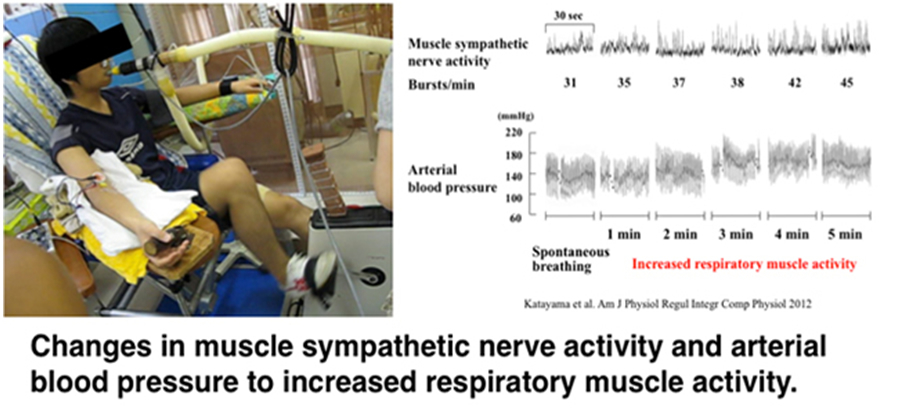
precise regulation of the respiratory and cardiovascular systems is required To meet the metabolic demands of active skeletal muscle during exercise. Appropriate control of sympathetic vasomotor nerve activity plays a crucial role in maintaining arterial blood pressure and facilitating blood flow delivery to active muscles. Central command (a feedforward mechanism originating from the cerebral cortex and/or subcortical nuclei), the exercise pressor reflex (a feedback mechanism originating from skeletal muscle, i.e., the metaboreflex and mechanoreflex), the arterial baroreflex (a feedback mechanism originating from the carotid sinus and aortic arch), and the cardiopulmonary baroreflex (a feedback mechanism originating from low-pressure, mechanically sensitive stretch receptors located in the heart, vena cava, and pulmonary vasculature) interact in a coordinated manner to form complex regulatory mechanisms governing sympathetic vasomotor outflow during exercise.
Among these regulatory systems, our research group aims to elucidate cardiovascular regulatory mechanisms during exercise, with a particular focus on the respiratory muscle metaboreflex and the cardiopulmonary baroreflex.
BIBLIOGRAPHY
2025
- Katayama K., Shiozawa K., Ishida K., Banno R., Kinoshita A., Iwamoto E., and Ogoh S. Inhibition of sympathetic vasomotor outflow during low-intensity leg cycling is attenuated in heathy older females. J. Appl. Physiol. 138: 1133-1142, 2025.
2024
- Katayama K., Shiozawa K., Lee J.B., Seo N., Kondo H., Saito M., Ishida K., Millar P.J., Banno R., and Ogoh S. Influence of sex on sympathetic vasomotor outflow responses to passive leg raising in young individuals. J. Physiol. Sci. 74: 19, 2024.
2023
- Shiozawa K., Saito M., Lee B.J., Kashima H., Endo YM., Ishida K., Millar J.P., and Katayama K. Effects of sex and menstrual cycle phase on celiac artery blood flow during dynamic moderate-intensity leg exercise in young individuals. J. Appl. Physiol 135: 956-967, 2023.
2022
- Katayama K., Saito M., Ishida K., Shimizu K., Shiozawa K., Mizuno S., Ogoh S. Sympathetic vasomotor outflow low-intensity leg cycling in healthy older males. Exp. Physiol. 107: 825-833, 2022.
2021
- Katayama K., Dominelli P.B., Foster G.E., Kipp S., Leahy M.G., Ishida K., and Sheel A.W. Respiratory modulation of sympathetic vasomotor outflow during graded leg cycling. J. Appl. Physiol. 131: 858-867, 2021.
2020
- Katayama K., Barbosa T.C., Kaur J., Young B.E., Nandadeva D., Ogoh S. and Fadel P.J. Muscle pump-induced inhibition of sympathetic vasomotor outflow during low-intensity leg cycling is attenuated by muscle metaboreflex activation. J. Appl. Physiol. 128: 1-7, 2020.
2019
- Katayama K., Goto K., Shimizu K., Saito M., Ishida K., Zhang L., Shiozawa K., and Sheel A.W. Effect of increased inspiratory muscle work on blood flow to inactive and active limbs during submaximal dynamic exercise. Exp. Physiol. 104: 180-188, 2019.
2018
- Katayama K., Smith J.R. Goto K., Shimizu K., Saito M., Ishida K., Koike T., Iwase S., and Harms C. Elevated sympathetic vasmotor outflow in respose to increased inspiratory muscle activity during exercise is less in young women compared with men. Exp. Physiol. 103: 570-580, 2018.
- Katayama K., Kaur J., Young B.E., Barbosa T.C., Ogoh S., and Fadel P.J. High intensity muscle metaboreflex activation attenuates cardiopulmonary baroreflex-mediated inhibition of muscle sympathetic nerve activity. J. Appl. Physiol. 125: 812-819, 2018.
2016
- Katayama K.,Ishida K., Saito M., Koike T., and Ogoh S. Hypoxia attenuates cardiopulmonary reflex control of sympathetic nerve activity during mild dynamic leg exercise. Exp. Physiol. 101: 377-286, 2016.
2015
- Katayama K., Suzuki Y., Hoshikawa M., Ohya T., Oriishi M., Itoh Y., and Ishida K. Hypoxia exaggerates inspiratory accessory muscle deoxygenation during hyperpnoea. Respir. Physiol. Neurobiol. 211: 1-8, 2015.
2014
- Katayama K., Ishida K., Saito M., Koike T., Hirasawa A., and Ogoh S. Enhanced muscle pump during mild dynamic leg exercise inhibits sympathetic vasomotor outflow. Physiol. Rep. 16: e12070, 2014.
2013
- Katayama K.,Yamashita S., Ishida K., Iwamoto E., Koike T., and Saito M. Hypoxic effects on sympathetic vasomotor outflow and blood pressure during exercise with inspiratory resistance. Am. J. Physiol. Regul. Integr. Comp. Physiol. 304: R374-R382, 2013.
2012
- Katayama K., Iwamoto E., Ishida K., Koike T., and Saito M. Inspiratory muscle fatigue increases sympathetic vasomotor outflow and blood pressure during submaximal exercise. Am. J. Physiol. Regul. Integr. Comp. Physiol. 302: R1167-R1175, 2012.
2011
- Katayama, K., K. Ishida, E. Iwamoto, M. Iemitsu, T. Koike, and M. Saito. Hypoxia augments muscle sympathetic neural response to leg cycling. Am. J. Physiol. Regul. Integr. Comp. Physiol. R456-R464, 2011.
2010
- Katayama, K., K. Goto, K. Ishida, and F. Ogita. Substrate utilization during exercise and recovery at moderate altitude. Metabolism 59: 959-966, 2010.
2007
- Katayama, K., M. Amann, D. F. Pagelow, A. J. Jacques, and J. A. Dempsey. Effect of arterial oxygenation on quadriceps fatigability during isolated muscle exercise. Am. J. Physiol. Regul. Integr. Comp. Physiol. 292: R1279-R1286, 2007.
2005
- Katayama, K.,K. Sato, H. Matsuo, N. Hotta, Z. Sun, K. Ishida, K. Iwasaki, and M. Miyamura. Changes in ventilatory responses to hypercapnia and hypoxia after intermittent hypoxia in humans. Respir. Physiol. Neurobiol. 146: 55-65, 2005.
2004
- Katayama, K., K. Sato, H. Matsuo, K. Ishida, K. Iwasaki, and M. Miyamura. Effect of intermittent hypoxia on oxygen uptake during submaximal exercise in endurance athletes. Eur. J. Appl. Physiol. 92: 75-83, 2004.
2003
- Katayama, K., H. Matsuo, K. Ishida, S. Mori, and M. Miyamura. Intermittent hypoxia improves endurance performance and submaximal exercise efficiency. High Alt. Med. Biol. 4: 291-304, 2003.
2002
- Katayama, K., Y. Sato, N. Shima, J. Qiu, K. Ishida, S. Mori, and M. Miyamura. Enhanced chemosensitivity after intermittent hypoxic exposure does not affect exercise ventilation at sea level. Eur. J. Appl. Physiol. 87: 187-191, 2002.
2001
- Katayama, K., Y. Sato, Y. Morotome, N. Shima, K. Ishida, S. Mori, and M. Miyamura. Intermittent hypoxia increases ventilation and SaO2 during hypoxic exercise and hypoxic chemosensitivity. J. Appl. Physiol. 90:1431-1440, 2001.
2000
- Ishida, K., Y. Sato, K. Katayama, and M. Miyamura. Initial ventilatory and circulatory responses to dynamic exercise are slowed in the elderly. J. Appl. Physiol. 89: 1771-1777, 2000.
MESSAGE
We are seeking graduate students who are interested in exercise and training as well as the respiratory and cardiovascular systems. Our laboratory has welcomed students from a wide range of academic and professional backgrounds, including graduates of sports-related programs, registered dietitians, physical therapists, and physicians. Many of our graduates have gone on to pursue successful careers as university faculty members.
Exercise is a vital theme closely linked to both health and medicine. We hope that the knowledge and research experience gained in our laboratory will be valuable in future clinical and educational settings. Would you like to join us in conducting research in the field of health and sport sciences?
