Clinical Exchange in Japan
Welcome to Japan and Nagoya University school of Medicine!
Experience report
Name: Heng Yanxi
School: Peking University, China
Study Period: 2025/11/4 - 2025/11/28
Departments: Ophthalmology, Cardiology
I am deeply honored to have participated in a four-week clinical clerkship at Nagoya University School of Medicine in the autumn of 2025.
In the first week, I joined the Catheterization Laboratory and Operating Room of the Department of Cardiology, observing under multiple treatment teams including those specializing in pulmonary hypertension, TAVI, cardiac ablation, and heart failure. Supervising physicians introduced patients' basic conditions, reviewed disease-related knowledge with me, and explained key surgical points. I was particularly impressed by the follow-up evaluations of two post-cardiac transplantation patients—they underwent interventricular septal biopsy to screen for immune rejection, Swan-Ganz catheterization to assess cardiac function, and echocardiography to check for effusions.
During the second week, I participated in Cardiology clerkships alongside fifth-year medical students from Nagoya University. The activities included small-group lectures (on topics such as PCI, hemodynamics, nuclear medicine, ECG, and arrhythmias) and simulation training (e.g., echocardiography and endovascular treatment). The echocardiography simulation was especially rewarding—it was my first time operating an ultrasound probe, successfully visualizing parasternal long-axis, parasternal short-axis, and apical four-chamber views, which further deepened my ability to interpret echocardiography reports.
In the third week, I transferred to the Department of Respiratory Medicine and continued my studies with fifth-year medical students, focusing on group lectures (e.g., chest X-ray, respiratory infections) and simulation training (including bronchoscopy, auscultation, and thoracentesis). The auscultation simulation was especially memorable—it was my first experience with such professional equipment, and identifying standardized breathing murmurs in simulated scenarios effectively enhanced my ability to recognize physical signs in real clinical settings.
In the fourth week, I followed respiratory department instructors into actual clinical work. physicians managing inpatient wards took me on bedside rounds (primarily for patients with lung cancer or interstitial lung disease) and detailed their conditions; consulting physicians invited me to communicate with patients about their medical histories and jointly develop treatment plans; and procedural faculty allowed me to observe the entire process of pleural effusion aspiration and closed drainage. Additionally, the SOAP (Subjective, Objective, Assessment, Plan) documentation format used at Nagoya University Hospital differed from that in Chinese hospitals, providing me with new insights.
Throughout the rotation, all instructors were incredibly warm and enthusiastic in their teaching, helping me integrate into the team quickly. I would like to express special thanks to Professors Yura and Ando for explaining the rotation schedule in detail and guiding me around; and Professors Adachi and Ando as well as Ms. Nanya for kindly inviting me to lunches and desserts. Their care made me feel truly welcome.
Furthermore, I had in-depth exchanges with Japanese medical students and forged precious friendships during joint dinners. We discussed topics such as the medical education systems in China and Japan, university life, living expenses, academic pressure and research requirements, popular specialty choices, and salary levels. For instance, I learned that Japanese medical education consists of a 6-year undergraduate program, followed by 2 years of residency training and examinations to obtain a medical license and determine a career direction. In contrast, Chinese medical students confirm their career direction after 5 years of undergraduate study, then complete 3 years of standardized residency training and examinations before practicing medicine formally. Additionally, Japanese medical students have more free time to experience campus life or take part-time jobs, while Chinese medical students need to invest more effort in research projects to enhance their employability.
Overall, this has been an unforgettable experience that I will cherish for a lifetime.
Finally, I extend my sincere gratitude to the Office of International Affairs for providing detailed guidance and support for the smooth implementation of this exchange program. I look forward to having the opportunity to visit the Department of Medicine, Nagoya University again in the future to further deepen academic exchanges and learning!
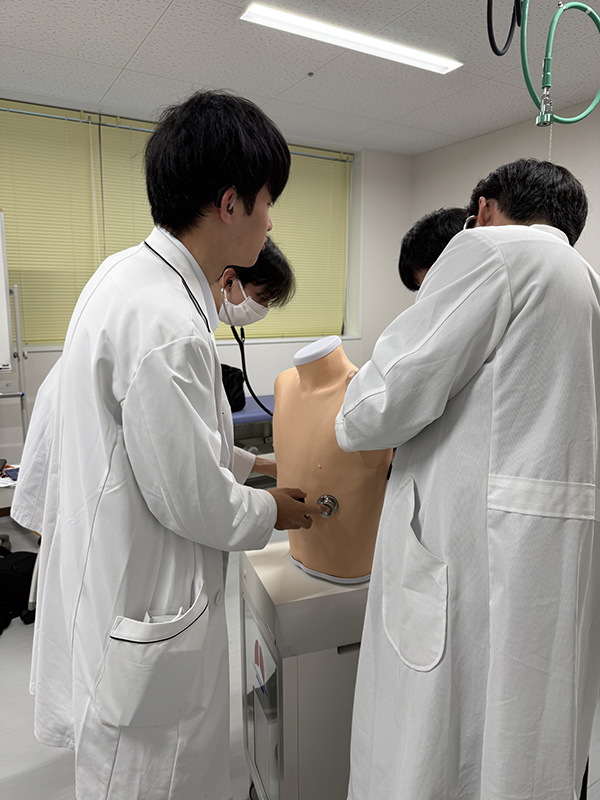
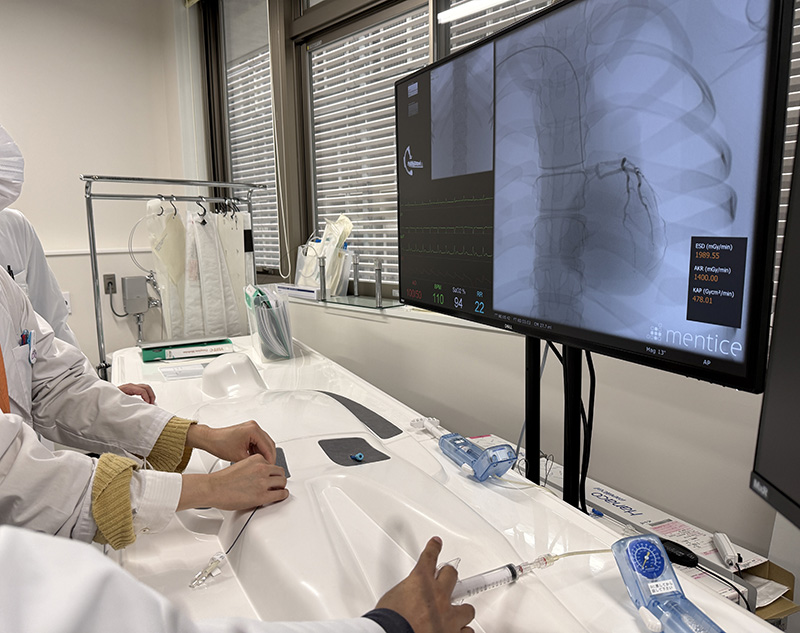
(left) Auscultation (right) Endovascular treatment
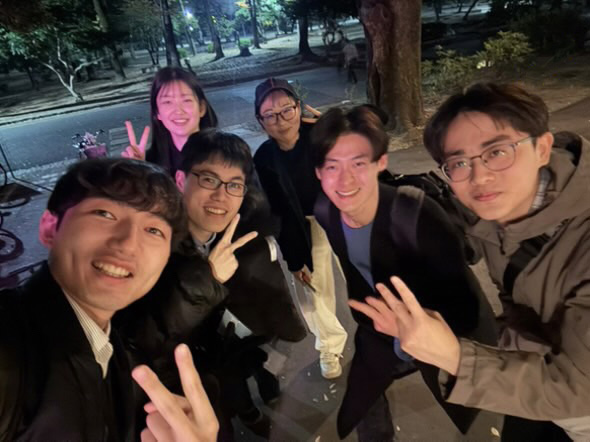
Joint dinner
Click here to read other stories
Nagoya University Graduate School of Medicine